

WHEN MARY RISES
(and the restoration of the first apostle)

In the absence of Christ’s physical presence, Mary rises.
“Then Mary stood up and greeted them; she tenderly kissed them all and said, ‘Brothers and sisters, do not weep, do not be distressed nor be in doubt. For his grace will be with you sheltering you. Rather we should praise his greatness, for he has united us and made us true Human beings.” –The Gospel of Mary
Let’s consider the significance of this both literally and symbolically.
Literally.
Mary Magdalene, as a woman in the first century, would have been considered the least among them. The patriarchal social structure of the Roman Empire viewed females as subhuman. Only the male body was considered to be a whole human being.
So, the male disciples would have existed in a world that supported their misunderstanding of being fundamentally superior to Mary.
Yet, here in her gospel, Mary Magdalene is the one to stand among them.
She is the one with the capacity to become the voice of love even in the absence of it. Even as she mourns with them the loss of Christ’s physical presence, and even as they all fear their own persecution, Mary rises.
And when Mary rises she tenderly kisses them, reassures them, reminds them of the most important truth: because of Christ, they are united. They are no longer separated into the unjust categories of “whole human beings” and “subhumans.”
All of them, no matter how they may have ranked in worth according to the empire, all of them have been united together as true human beings.
This concept of the true human being in The Gospel of Mary suggests that our work here is to become ever more aware of the fact that we are fully human, and fully divine. Both and, not either or.
We are a messy ego, with all the passion and desire it commands, often wreaking havoc on our lives. And also, we are a soul of love, that’s immortal, and otherworldly, and that constantly tries to whisper from within us how to align with a force, a power that’s beyond comprehension.
If we take The Gospel of Mary seriously, if we consider it as sacred and as holy as all the other scripture codified in the New Testament, then a powerful message becomes clear when it’s Mary Magdalene who stands up to comfort the disciples after the crucifixion.
It’s a message we’re still trying to live into, and fully embody: all of us, no matter who we are, no matter what our physical form looks like– we’re all worthy of becoming a voice of love even in the absence of it.
We’re all worthy of hearing that voice of love that has been wanting to get through to us for eons.
That voice that asks us to be kinder to ourselves, to have mercy on what we haven’t figured out yet. That voice that comforts us when we wake up in the middle of the night, sweating with regret. That voice that comes as if from another time, another place, and yet allows us to finally come home to ourselves. That voice that finally lets this body be the holiest place on earth. That voice that allows this body to be the safest place we’ve ever known.
That voice wanting only, ever to guide us in ways the mind can’t fathom.
That voice of unending, and undying love.
If we take The Gospel of Mary seriously, then we see the teaching inherent in the fact that it’s Mary Magdalene who rises among the disciples. It’s Mary that becomes the physical presence of love in Christ’s physical absence. It’s the least among them, the one who was considered less than. It’s the one who had been overlooked and underestimated her entire life. It’s the one that never cared about power, or attention, or being right.
It’s the one that cared to be there, always, by his side. It’s the one who refused to leave, even in death. It’s the one who was there to meet him when he rose again. It’s the one he had instructed to be able to perceive him. And it’s the one who would be lied about and misunderstood for millennia.
Because when Mary rises, she takes us with her.
All of us, who have ever felt unworthy, we rise with her as she stands.
When Mary rises, she becomes the memory of the truth that no matter how the external world may label, and define us, no matter what category of existence we’ve been placed in, we are all human– comprised of a soul, and a raging ego, both.
Symbolically.
Mary Magdalene in this moment when she rises, doesn’t just represent womankind– she also represents the divine feminine. And the divine feminine has been as misunderstood and buried as Mary Magdalene has been maligned and disparaged.
The divine feminine is both the existence of female spiritual leaders and mystics and gurus and goddesses and bodhisattvas and dakinis and saints all throughout the history of world religions– and also– it’s the direct connection we all have to the divine from within the human body.
The divine feminine is how we know, meaning from the Greek word gnosis, or knowledge gained from direct experience, the divine, or the presence of love, from simply closing our eyes and going inward.
This is an aspect of our being that has been a part of every religious tradition.
The divine feminine is the other half of how we know the divine. We can study theology, we can go to church or synagogue or temple to worship. We can talk and tell stories about the divine. We can make a pilgrimage to a holy place. Those are all external forms of finding the divine.
The divine feminine is closing our eyes right now, being still, and knowing god.
The divine feminine is the aspect of our humanity that doesn’t need permission or external affirmation of our worth to meet with the divine. The divine feminine is the practice of going inward no matter where we are or what’s expected of us, and merging with that presence of love that waits for us to return to it.
The divine feminine is what allows us all to know love, directly.
When Mary rises, she embodies, and models that knowing love from within, and letting that love speak through us is our collective calling.
When Mary rises, as the first apostle, the divine feminine is restored as the other half of how we encounter the divine– or the other half of how we know who we are.
WHEN MARY RISES
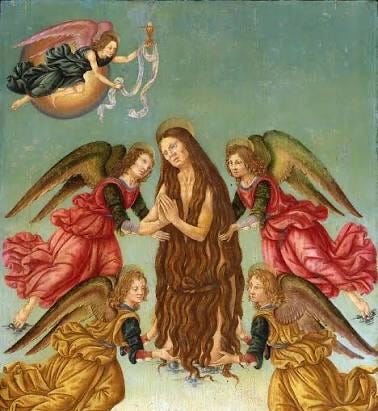
The restoration of the first apostle
and the reclamation of the divine feminine.
Join in virtually for the Saturday afternoon session of best-selling author and feminist theologian Meggan Watterson’s popular retreat Mary Magdalene Revealed. Watterson shares profound teachings from The Gospel of Mary and the history behind the gospel’s erasure. We’ll explore why these teachings were so threatening to the early church, and why they are still as potent and life-changing as they were in antiquity. And we’ll understand the importance of correcting the lie told about Mary Magdalene for millennia– that she was a prostitute. Mary Magdalene was not a prostitute. Mary Magdalene was the first apostle with a message meant for all of us.
Join this immersive program designed to bring the Rhinebeck campus directly to you.
Participate in Meggan Watterson’s signature retreat on Mary Magdalene based on her Wall Street Journal best-selling book Mary Magdalene Revealed
Discover the most powerful teachings Christ gave intentionally to Mary Magdalene
Practice a form of meditation inspired by The Gospel of Mary
Access the recording for six months from the event start
THE MARY MAGDALENE REVEALED RETREAT
THE OMEGA INSTITUTE
Rhinebeck, New York | August 21 - 23, 2026
The Gospel of Mary Magdalene was ordered to be destroyed in the 4th century. Why?
The Gospel of Mary reveals a transformational power that exists within all of us, no matter who we are.
The Gospel of Mary, and other texts labeled “apocryphal,” or “of doubtful authenticity,” like The Acts of Paul and Thecla challenged the patriarchal structure of power in the 1st century by demonstrating that women were as worthy as men to hold positions of spiritual authority.
And to find this transformational power, all we need to do is turn inward, be still, and acquire a form of spiritual perception The Gospel of Mary refers to as “the eye of the heart.” This allows us to see past the ego of our own little lives to what’s more real, and lasting, and infinite, and already here, within.
Through lecture, lively discussion, and practice of the soul-voice meditation, we’ll discover the secret teachings Christ gave to Mary, why she was uniquely meant to receive them, and why they’re radical, even for today.
We’ll return home with a personal experience of the love The Gospel of Mary reveals, the love that has the power to change everything.
Meggan, your words reach me in the most undeniable ways, and I feel parts of me rise, rejoice, and realign all at once.
It is as though I’m learning something for the first time that I’ve also known all along. ✨
Let your work and her legacy and the divine feminine rise ✨️ 🙌 🔥❤️⚓️🕊